Closing the diagnostic gap in uterine cancer.
We exist to address a systemic gap in women's health: the lack of a standardized, consistently implemented framework for the early detection of endometrial cancer.
Symptoms are not screening.
Waiting for a warning sign is not prevention, it is reaction. We believe the next chapter of endometrial cancer care must be proactive, routine, accessible, and expected.
Three things have to change at once.
We are here to change what women know to ask for, what clinicians know to offer, and what families understand is at stake.
What women know to ask for
Empowerment. We help women understand their risk, recognize the warning signs, and walk into the exam room knowing the questions to ask.
What clinicians know to offer
Collaboration. We support the shift toward proactive, risk-aware, office-based evaluation, so the system meets women earlier instead of later.
What families understand is at stake
Advocacy is not gendered. We bring husbands, fathers, sons, and brothers into the work, because everyone who loves her has a role to play.
A gap hiding in plain sight.
Unlike other areas of women's health, where routine screening has become embedded in standard medical practice, endometrial cancer currently lacks a normalized early-detection paradigm. In practice, detection is often reactive, dependent on the onset of symptoms rather than proactive evaluation or standardized expectations within routine gynecologic care.
The result is variability in awareness, inconsistency in evaluation, and disparities in patient outcomes. Some women are caught early. Many are not. And too often, the difference comes down to luck.
Symptoms are the flames. Screening is the smoke detector.
By the time the flames are visible, the fire is already burning. A smoke detector warns you before. For uterine cancer, there is still no smoke detector, only the fire.
We exist to replace that variability with expectation, to make earlier evaluation something women understand, ask for, and receive.

Wait for symptoms
Women are taught to react to abnormal bleeding or pelvic pain, frequently after the disease has already progressed. Awareness is uneven, and evaluation is inconsistent.
Expect early detection
A culture, like the one earlier screening created for cervical cancer, in which proactive evaluation becomes routine, informed, and expected as part of women's health.
Upstream, where almost no one is.
There are many good organizations in women's cancer. But almost all of that work begins after a diagnosis: research, treatment, patient support, advocacy. That work matters enormously. It is also downstream.
What barely exists is the infrastructure upstream, before symptoms ever appear: normalizing the idea of early detection, clarifying when evaluation should fit into routine care, and getting patients and clinicians to expect the same things at the same time. That gap is where we work.
This is not only a technology problem. Even the best test fails if it never reaches women.
Outcomes change at scale only when education, clear pathways, and clinical alignment exist around detection. We are building that connective tissue, the system that turns a good idea into something a woman actually receives.
We are in formation. We are building deliberately, in phases, with medical advisory input. We would rather be durable than fast. The goal is not to look big. It is to change the standard, and to last.
Three convictions guide everything.
Earlier is everything
The window for better outcomes opens early. Our work is to widen it, through awareness, education, and changed expectations.
Families, not just patients
A diagnosis reshapes everyone who loves her. We speak to the whole family, including the men and boys too often left out of women's health.
Equity is non-negotiable
Disparities in awareness and access drive disparities in outcomes. Reaching the women facing the greatest barriers is central to the mission, not an afterthought.
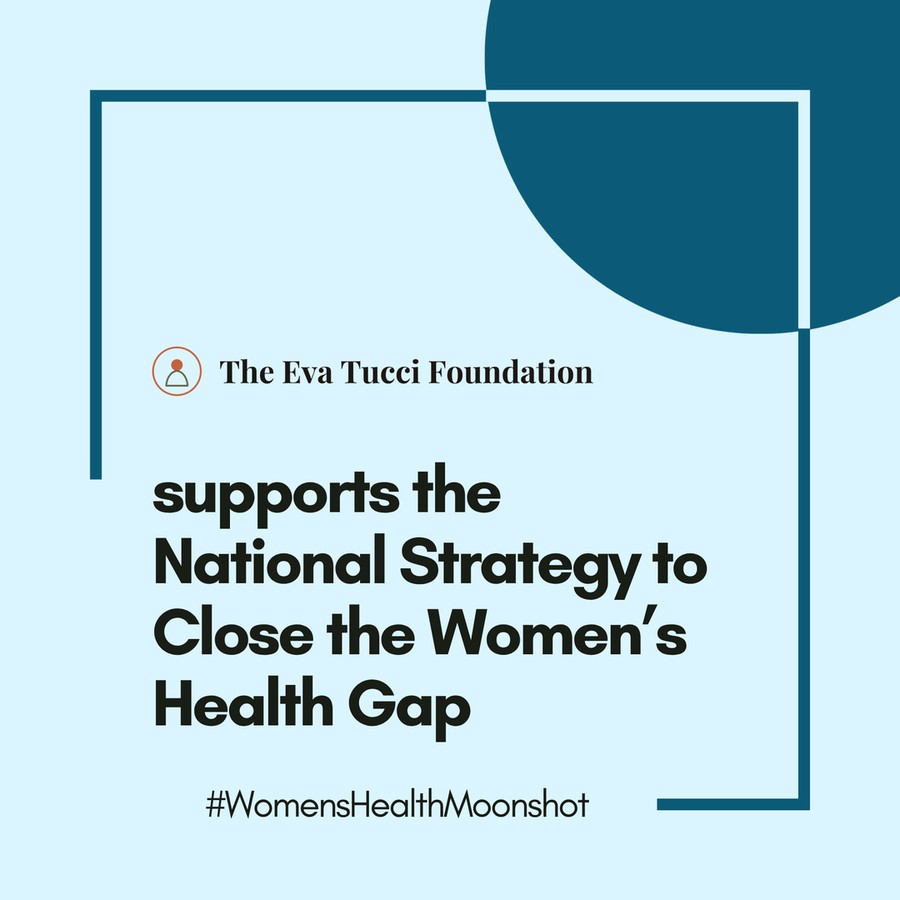
We have endorsed the National Strategy to Close the Women's Health Gap.
In August 2026 the Foundation joined more than fifty organizations endorsing the National Strategy to Close the Women's Health Gap, a $20 billion, ten-year federal framework launched by the Society for Women's Health Research, the American College of Obstetricians and Gynecologists, and the Women First Research Coalition.
Our work sits inside its Public Awareness and Education pillar, which proposes $1 billion and carries one action item: to plan and launch national women's health campaigns. We are the first patient advocacy organization for uterine and endometrial cancer to endorse it.
Where the Foundation came from, and how it is funded.
The Foundation is named for Eva Tucci. The idea for it began at Utepreva, a women's health company working in endometrial cancer, which provided our founding support.
The Eva Tucci Foundation is separately incorporated and recognized by the IRS as tax-exempt under Section 501(c)(3). It is governed by its own Board and makes its own decisions about what it funds, what it publishes, and what it says. Our educational materials are developed independently and do not promote any specific product, technology, or company, including Utepreva.
We state this plainly because no one should have to go looking for it.
A mission becomes real through programs.
Our work is organized into five coordinated program areas designed to function together as one system, from public education to access and equity.